
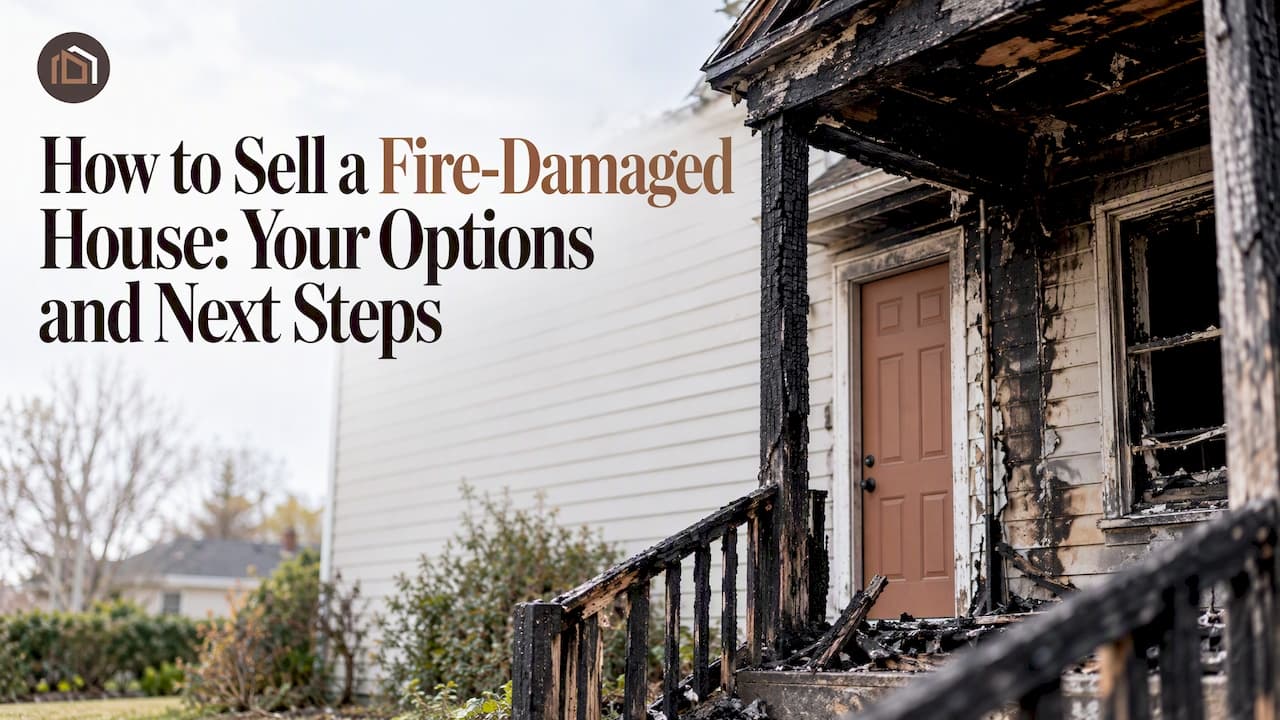
You can sell a fire-damaged house, and homeowners do it every year. You can repair it and list it, sell it as-is to a buyer who takes on the work, or sell the land. The right choice depends on how bad the damage is, what your insurance covers, how much cash and patience you have, and what you owe on the mortgage. This guide covers the order of steps, the legal duty to disclose, how insurance and a sale fit together, and how to compare offers without being rushed.
TL;DR
- Stay out of the building until local fire authorities clear it, then document everything before you clean up or sign anything.
- Selling does not have to cancel your insurance claim. Treat the claim payout and the sale proceeds as two separate money streams, and get your insurer's position in writing.
- Every state expects you to disclose known material defects, and fire damage is one. Hiding it can lead to a lawsuit long after closing.
- Your main routes are repair-then-list, sell as-is, or sell the land. Compare what you would actually keep after costs and time, not just the headline price.
- Get an independent assessment and read any written offer carefully before you agree to anything.
Table of Contents
- Start with safety and documentation
- Why fire damage is harder to judge than it looks
- Your three main ways to sell
- Insurance and selling are not either/or
- Disclosure: what you owe the buyer
- How to compare offers
- Perspective: what we see sellers get wrong
- When a direct sale makes sense, and what we offer
- Common mistakes to avoid
- A sensible order of operations
- FAQ
- Sources
Start with safety and documentation
Before you think about price, think about the building. The U.S. Fire Administration's guide for fire survivors says you should not go back into a fire-damaged home until the fire department says it is safe. Ask the fire officials to confirm that utilities are secured, too. A structure that looks fine from the doorway can have weakened floors, damaged wiring or lingering hazards.
Once you are cleared to enter, resist the urge to start hauling things out. The National Association of Insurance Commissioners (NAIC) advises documenting all losses before removing any debris or belongings. Photograph and video every room, and make lists of damaged items. That record supports your claim, and it will later support an honest conversation with any buyer about what happened and what was affected.
A practical first-week checklist:
- Call your insurance company and open a claim. Keep every communication in writing, or follow up phone calls with an email.
- Ask the fire department for the incident report and keep a copy.
- Photograph and video the property, inside and out, before anything is moved.
- Secure the property against weather and trespassers. Ask your insurer what temporary protection they cover.
- Contact your mortgage servicer. If you have a loan, the lender has an interest in the property and in how claim money is handled.
- Hold off on signing contracts with anyone who knocks on your door.
That last item matters. NAIC warns homeowners to be wary of aggressive contractors who show up after a disaster asking for immediate payment or trying to control the claim. A person offering to "handle everything" before you have even read your policy is a red flag, whether they want to fix the house or buy it.
Why fire damage is harder to judge than it looks
A scorched kitchen or a blackened attic is easy to see. The rest is not. Redfin's guide to selling after a fire notes that damage is usually systemic, not cosmetic: smoke is acidic and keeps corroding materials, and the water used to put out the fire can lead to hidden mold. Even when a house seems repairable, HVAC and electrical systems may have damage you cannot see.
This has two consequences for a sale.
- Your own estimate of the damage is probably off. Rooms untouched by flames can still carry smoke damage, odor and moisture problems. Get an assessment from a licensed contractor, a structural engineer or a restoration professional who is not the same person who would be paid to do the work.
- Buyers will assume the worst until shown otherwise. A documented, independent assessment gives every buyer, cash or conventional, the same facts. It tends to make offers more grounded and conversations shorter.
The fire department's view of the incident is not a valuation. Treat it as the start, and bring in someone to look at framing, roof, wiring, plumbing, HVAC and moisture.
Your three main ways to sell
Most advice on this topic, including Redfin's, boils down to three routes. They are worth laying side by side, because the best one depends on your situation rather than on a rule.
| Repair, then list | Sell as-is | Sell the land | |
|---|---|---|---|
| Who buys | Traditional buyers with financing | Cash buyers and others who can handle a damaged property | Builders, developers, or owners who plan to rebuild |
| Upfront money needed | High: you fund repairs | None for repairs | Possibly demolition or cleanup, depending on the deal |
| Time | Longest: repairs plus a normal listing | Often the shortest | Varies with the buyer and the lot |
| Price pressure | Closer to pre-fire value if the work is done well | Lower, because the buyer takes on cost and risk | Based on the lot, not the structure |
| Best when | Damage is limited, you have funds and time | Damage is heavy, or you cannot or do not want to manage repairs | The structure is a total loss |
Repair, then list
If the damage is contained and you have the money and patience, restoring the house can lead to a sale at a higher price. The trade-off is time and risk. Repairs can uncover new problems, permits take time, and you carry the mortgage, taxes and insurance through the whole process. You also need a plan if the insurance payout arrives in stages. NAIC notes that settlements for major disasters are complex and can take 18 to 24 months, so do not assume the cash will be there when the contractor's first invoice arrives.
Sell as-is
Selling as-is means you hand over the property in its current condition and the buyer decides what to do with it. You skip the repairs, the contractor management and the carrying costs of a long project. The price will reflect that, since the buyer takes on the work and the uncertainty. For many owners, particularly those who are exhausted, relocating, or facing a loan that is still due, the certainty of a clean exit outweighs a higher but slower number.
As-is does not mean without paperwork. You still disclose what you know, and you still want a written contract with clear terms, a closing handled by a licensed title or escrow provider, and time to read it.
Sell the land
When the structure is a total loss, the value may sit in the lot itself. Builders and developers may be interested, and so may neighbors. Ask about demolition responsibility, debris removal and any permits, and settle in the contract who pays for what.
Insurance and selling are not either/or
The most common worry we hear is that selling means giving up the insurance payout. Redfin's guide makes the point that this is a misunderstanding: recovery often combines the claim payment with net proceeds from an as-is sale. Think of two streams of money. One comes from your insurer for the loss. The other comes from the buyer for the property.
That said, the details depend on your policy and your lender, so do these things before you list:
- Ask your insurer, in writing, how a sale affects your open claim and what happens to amounts not yet paid.
- Read how the settlement is calculated. NAIC explains that an adjuster reviews your policy and calculates the damage to your home and belongings. Know which parts of your payment cover the structure, which cover contents and which cover living expenses, since each can behave differently if you sell.
- Talk to your mortgage servicer about how claim checks are handled while a loan is outstanding and what the payoff would be at closing.
- Avoid signing away benefits. NAIC publishes guidance on reading the fine print before signing documents after a storm or disaster. The same caution applies to any release or assignment a buyer or contractor hands you.
If your claim involves a large loss or a dispute, a licensed public adjuster or an attorney who handles insurance claims can review your situation. For tax questions about a casualty loss or a sale, speak to a CPA.
Disclosure: what you owe the buyer
Fire damage is a known material defect, and sellers are expected to disclose such defects on state disclosure forms. A summary of the research available says that in every state, failure to disclose can expose a seller to litigation years after the sale. Forms and rules differ by state, so check yours with a local real estate attorney.
In practice, honest disclosure means:
- Stating that a fire occurred, when, and where in the structure.
- Sharing the fire department report and the damage assessment you have.
- Saying whether an insurance claim is open, settled or denied.
- Listing any repairs already done, who did them and whether permits were pulled.
- Not downplaying smoke, water or mold issues you know about.
There is a practical upside. Buyers who see a complete file trust it, and negotiations stay focused on price and terms. A seller who tries to shave the story invites re-trades, delays or lawsuits.
As for how long a seller stays on the hook after closing, there is no single answer. It depends on your state, on what you disclosed and on what the contract says. Ask a real estate attorney, and have the contract reviewed before you sign.
How to compare offers
Headline numbers are misleading when a house is damaged. Put each option into a simple net sheet.
- Price you would be paid.
- Minus repair costs you would fund (if any).
- Minus agent commissions, if you list traditionally.
- Minus carrying costs while you wait: mortgage payments, property taxes, insurance, utilities.
- Minus closing costs and any loan payoff.
- Plus insurance proceeds, which you treat separately.
- Weigh how long each route takes and how certain the closing is.
When you run the sheet honestly, a lower as-is price can come out close to a higher repaired price once repairs, fees and months of carrying costs are counted. In other cases the repaired route clearly wins. Neither is true in advance. Run the numbers with real quotes.
A few things to ask any buyer:
- Is the offer in writing, with the price, closing date and conditions spelled out?
- Who pays closing costs?
- Is there an inspection period, and what can change the price after it?
- Which licensed title or escrow company will handle closing?
- Can I have my own attorney or advisor review the terms first?
A buyer who answers these clearly and does not push you to decide in a day deserves more of your time than one who does.
Perspective: what we see sellers get wrong
We talk to homeowners who are tired, stressed and often unsure whether they even have a sale. The pattern is the same. They think they have to decide everything at once: insurance, repairs, selling, moving. They do not.
Our view is that clarity should come before any commitment. That is why our process starts with a preliminary estimate based on very little information, and a no-obligation review. You see where you stand before you decide anything. If cash is the right route, we explain it. If a seller financing structure fits better, we lay that out too, with the options compared side by side in writing and the closing coordinated by licensed closing providers.

We also recommend independent reviews at every step: your own attorney, your insurance contact, your own contractor's opinion. We would rather you decide with full information than sign quickly. A fair offer holds up under scrutiny, and a fire is already a hard enough time without being hurried.
One more point. Do not feel that an as-is sale means a lesser outcome. If the repair route would drain your savings, drag on for a year and leave you carrying a loan on an empty house, a clean sale with clear written terms may be the more sensible result.
— Joshua
When a direct sale makes sense, and what we offer
A direct as-is sale tends to fit when the damage is significant, when you are not able to fund or manage repairs, when you have to relocate, or when carrying costs are piling up. It tends not to fit if you have a small, clearly repairable loss, strong cash reserves and time to wait for a retail buyer.
If you want to see where you stand, Elevate Home Acquisitions offers a private property evaluation, cash purchase and seller financing options. You start with minimal details about the property, receive a non-obligatory evaluation and, where it fits, a potential cash offer, with the terms put in clear written form. You decide whether to go ahead. We do not publish prices, because every damaged property is different and an estimate means little until we know the facts.
You can also look at our main site for how the process works.
Common mistakes to avoid
- Going back in too soon. Wait for clearance from the fire authorities.
- Cleaning up before documenting. You can weaken your claim.
- Signing with the first person who calls. Post-disaster solicitations are a known fraud risk.
- Treating the claim and the sale as one decision. They are separate streams of money with separate rules.
- Skipping disclosure. It rarely saves money and can cost much more later.
- Relying on one opinion of the damage. Get an independent assessment.
- Ignoring the lender. Your mortgage servicer needs to be in the loop before closing.
A sensible order of operations
If you want a simple sequence, this is it.
- Safety first: clearance from fire officials, utilities secured.
- Document damage, then open the claim and keep everything in writing.
- Get an independent assessment of structure, systems, smoke and moisture.
- Ask your insurer and lender how a sale would affect the claim and the loan.
- Gather estimates for the repair route and at least one written as-is offer.
- Build the net sheet and compare both timelines.
- Have an attorney review the disclosure and the contract.
- Close through a licensed title or escrow provider.
You do not need to do this in a week. You do need to do it in order.
FAQ
Can I sell a house that has fire damage?
Yes. You can repair it and list it, sell it as-is, or sell the land if the structure is a total loss. Whichever route you pick, you need to disclose what you know about the damage and the claim. Run a net sheet for each route before deciding.
Do I lose my insurance money if I sell?
Not necessarily. Many sellers assume a sale cancels the claim, but recovery often combines the payout with proceeds from an as-is sale. Your policy and lender decide the details, so get your insurer's answer in writing before you sign a sale contract.
Do I have to tell buyers about the fire?
Yes. Fire damage is a known material defect, and sellers are expected to disclose it. Leaving it out can expose you to a lawsuit after closing. Ask a real estate attorney in your state what your disclosure form requires.
How long does a sale take?
It depends on the route. Repairing and listing takes the longest, because you add repair time to a normal sale. As-is sales to buyers who do not rely on mortgage approval are often quicker, though the exact timing depends on title, your lender and the terms you agree.
Does a fire reduce what the house is worth?
It usually does, and by how much depends on the extent of damage, including smoke, water and systems you cannot see. An independent assessment is the best way to get a realistic figure rather than guessing.